A Corner That Asks Nothing of You
Mardle has a favourite place in our house, and he’s never once been in any doubt about where it is.
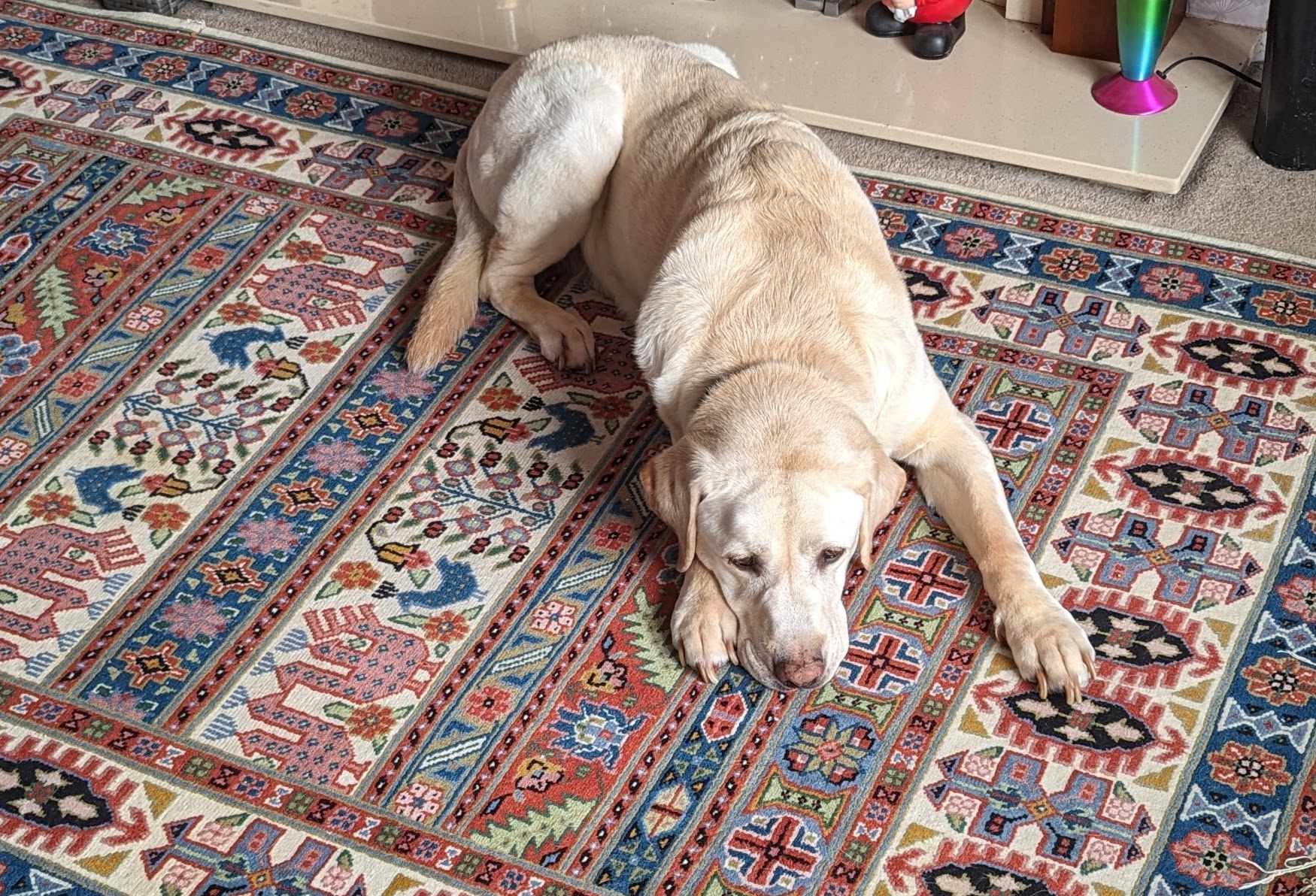
It’s the big rug in front of the living-room fireplace. It doesn’t matter whether the fire is lit or not. If we’re sitting in the living room, that’s where he’ll be, stretched out, chin on his paws, perfectly content.
Mardle is fourteen now, a retired guide dog who spent his working life paying close attention to the world around him. Fire lit or not, that’s where you’ll find him. It isn’t the warmth he’s after; it’s the view.
And watching him on that rug, we realised he’s chosen it very carefully.
From there, he’s close to us. But he can also see the front door, and the kitchen. Nothing can come or go without him knowing about it, and yet he’s warm, settled and right beside the people he loves.
It turns out there’s a name for what Mardle has found.
Prospect and refuge
In 1975, a geographer at the University of Hull called Jay Appleton published a book called The Experience of Landscape. Hull happens to be where we were both born and grew up, where we met, married and raised our three boys, so we were delighted to find him there. In his book, Appleton asked a simple question: why are some places so much more comfortable to be in than others?
His answer was that we’re drawn to places that give us two things at once. He called them prospect and refuge. Prospect is a view: the chance to see what’s going on around us. Refuge is shelter: the feeling of being safe and tucked away. The places we find most restful, Appleton suggested, are the ones that offer both, where we can see without feeling exposed.
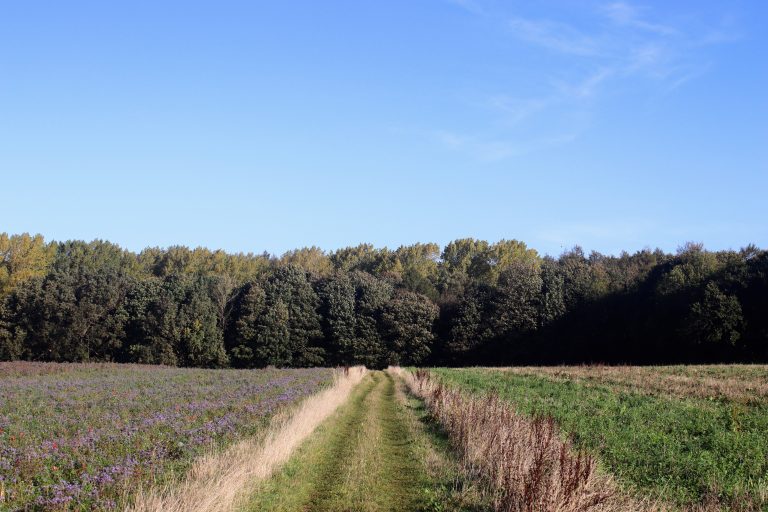
Think about where people choose to sit in a café. Almost nobody picks the table in the middle of the room if there’s one free against the wall or by the window. Think of a window seat, a porch, a bench at the edge of a wood looking out over a field. They all have a view, and something at our back.
Mardle’s rug is exactly that. The fireplace and the people he loves are his refuge. The front door and the kitchen are his prospect. He worked it out without reading a word of Appleton.
Prospect is a view. Refuge is a shelter.
The heart of the home
There’s another reason that spot by the fireplace feels right, and it’s written into our language.
The Latin word for hearth, the fireplace at the centre of a home, was focus. It meant the fire, and by extension the home and the family gathered round it. Centuries later, the astronomer Johannes Kepler borrowed it to mean the point where things converge, and that’s the sense we use today.
So when we say something is the focus of a room, we’re quite literally saying it’s the hearth.
Even the word curfew comes from the fire. It’s from the old French couvre-feu, “cover fire”: the evening bell that told people to bank down their hearths for the night. For most of history, the fire was where the day gathered in and where it ended. Mardle doesn’t need the fire lit to know that. The hearth is still the heart of the room.
Why so many of us don’t have a corner like this
Here’s the thing we noticed when we started looking round our own home. Almost every space had a job.
The kitchen table is for meals, homework, post and paperwork. The sofa faces the television. The bedroom is for sleep, and increasingly for scrolling. The spare room has quietly become an office. Wherever we sit, something is waiting to be done.
Mardle’s rug is different. Nothing happens there except resting. Nothing is expected of anyone who lies on it.
We think that’s what a real sanctuary is. It isn’t about expensive cushions or a perfectly styled reading nook. It’s simply a corner that asks nothing of you.
Two kinds of rest
Mardle has taught us one more thing.
He has a second favourite place: his dog bed, further away from the bustle. He goes there during the day when we’re busy elsewhere in the house, usually when we’re upstairs, and late in the evening as bedtime gets closer. That’s where he does his deep sleeping.
So, he has two kinds of rest. On the rug he rests with us, close and watchful, part of the life of the house. In his bed he rests away, when it’s time to really let go.
On the rug he rests with us, in his bed he rests away.
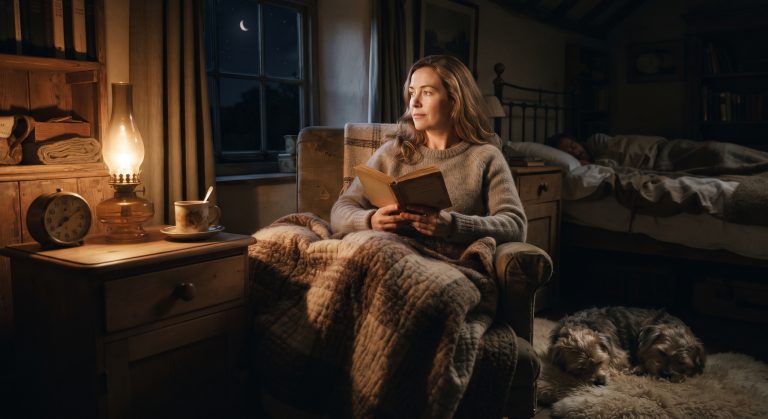
We need both of those too. A place where we can be still while life carries on around us, and somewhere further away where nobody needs us for a while. If your home has one but not the other, it’s worth asking which you’re missing. None of this needs money or a makeover. It might be the chair by the window that nobody uses, moved slightly so it faces the room. It might be one end of the sofa that becomes yours, with nothing piled on it. It might be a bench at the end of the garden where you can see the house but nobody can see the washing up.
A harbour with a view
We’ve always loved harbours, and we think we finally understand why.
A harbour is a refuge: sheltered water where boats can rest, out of the wind. But every harbour has a view of the open sea. You can sit on the harbour wall, warm and safe, and still watch the weather come in.
That’s prospect and refuge, exactly. It’s what Mardle found on his rug. And it’s what we can all make room for, somewhere in our homes: one small harbour with a view, that asks nothing of us at all.
If your quiet corner is outside, or you’d love to bring a little lavender to it, The Complete Lavender Garden Blueprint covers choosing the right variety, growing it in pots on a patio or balcony, and keeping it thriving for years. Find out more here
— Tracy & Chris (and Mardle)