
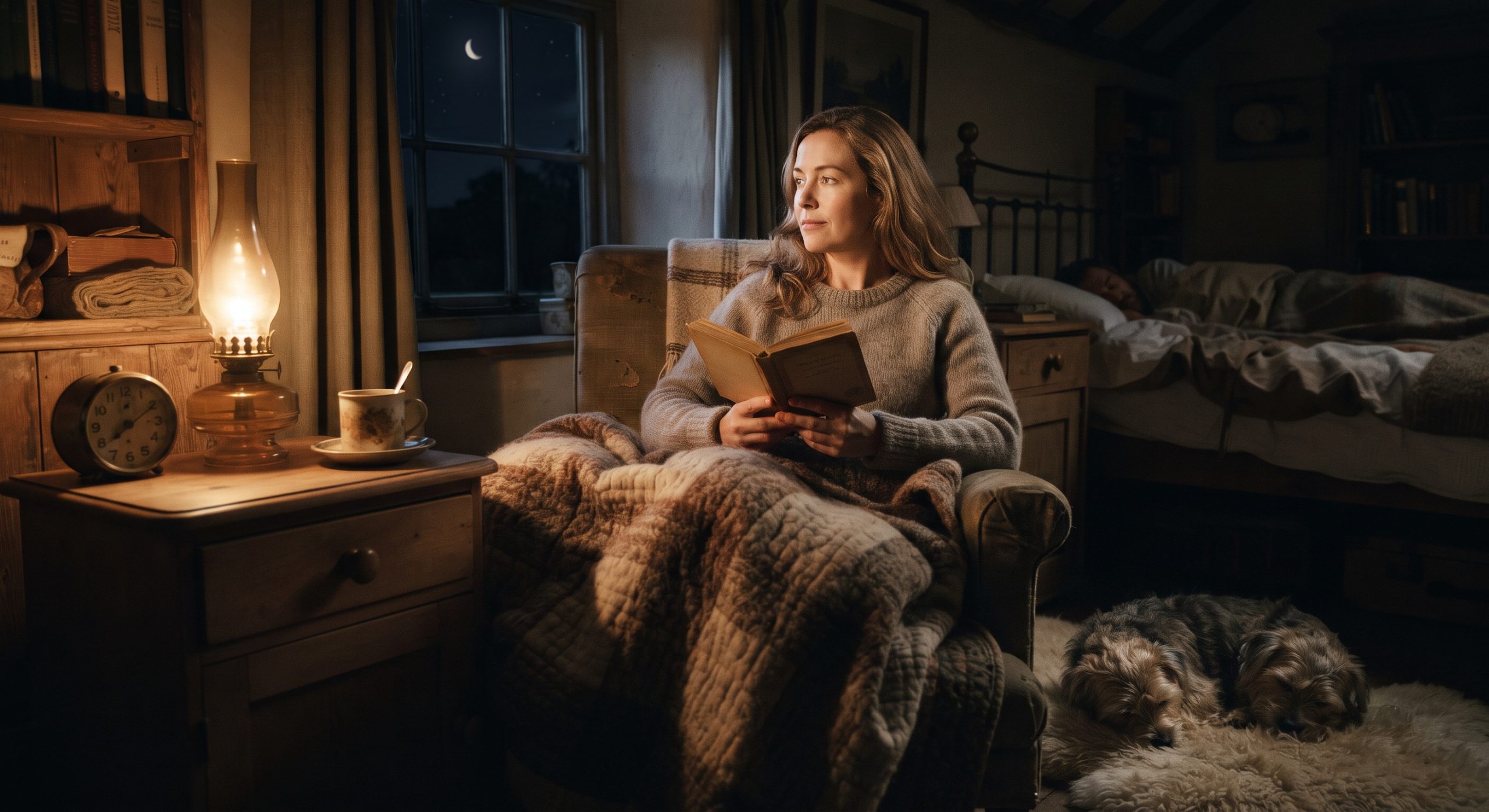
First Sleep, Second Sleep
It’s three o’clock in the morning and you’re awake.
Not startled awake, not unwell. Just awake. The house is quiet, the radiators have gone cold, and your mind has already found something to do: the email you didn’t answer, something someone said on Tuesday, the long list of tomorrow.
And underneath it all, a familiar worry: why can’t I sleep through the night like everyone else?
If that sounds like you, we’d like to share something that might take a little of the weight off. For most of history, waking in the middle of the night wasn’t seen as a problem at all. It even had a name.
Two sleeps, not one
In the 1980s and 90s, an American historian called Roger Ekirch was researching what night-time was like before electric light. Reading through old court records in London, he kept coming across a phrase he didn’t expect: people describing something that happened “after their first sleep”.
Once he started looking, he found it everywhere: in diaries, medical books, prayer books, legal papers and literature. Hundreds of references, stretching back centuries. He published his findings in 2001, and later in his book At Day’s Close.
The gap in the middle was simply part of the night.
What he pieced together was this. People went to bed a couple of hours after dark and slept for a few hours. This was their first sleep. Then, some time after midnight, they woke naturally and stayed awake for an hour or so, before settling into their second sleep, which carried them through to morning.
Nobody seemed troubled by it. The gap in the middle was simply part of the night.
Chaucer mentions it in passing in The Canterbury Tales, written more than six hundred years ago. In “The Squire’s Tale”, the princess Canacee goes to bed soon after evening, sleeps her first sleep, and then wakes. He doesn’t explain it. He didn’t need to: his readers knew exactly what he meant.
What people did in the gap
This is the part we love.
The time between the two sleeps wasn’t spent staring at the ceiling, counting the hours until the alarm. People prayed. They lay quietly and thought over their dreams. They talked softly with whoever shared their bed. Some got up to eat a little, smoke a pipe or take a remedy, and a few even went to visit the neighbours. Doctors of the time advised sleeping on one side for the first sleep, then turning over for the second.
It was a quiet, unhurried hour that belonged to nobody but you.
Where it went
The two sleeps faded during the 1800s. Ekirch links the change to brighter lighting, later evenings and the fixed hours of industrial work. Lingering in bed began to be frowned upon, and one medical journal from 1825 even urged parents to train their children out of the habit. By the 1920s, the idea of a first and second sleep had all but vanished from everyday life.
In its place came a new expectation: one long, unbroken block of sleep, every night, from lights out to the alarm. Anything else started to look like failure.
A clue from the laboratory
In the early 1990s, an American psychiatrist called Thomas Wehr tried an experiment. He asked a group of volunteers to spend fourteen hours in darkness every night for a month, much like a long winter night before electric light.
By the fourth week, they were sleeping in two halves of around four hours each
By the fourth week, they were sleeping in two halves of around four hours each, with an hour or two of calm wakefulness in between. Nobody had told them to. It was strikingly close to the pattern Ekirch had found in the old records.
A gentle caution
We want to be honest here, because this story is often told more neatly than it deserves.
Not every historian agrees on how common two sleeps really were. A 2023 paper in the journal Medical History questioned how widespread and tidy the pattern was, and Ekirch has since replied in defence of his evidence. And when researchers in 2015 studied three communities in Tanzania, Namibia and Bolivia who live without electricity, they found people mostly slept in one main stretch, not two. Interestingly, insomnia was so rare that two of those communities had no word for it.
So, we’re not saying broken sleep is the “natural” way, or that you should aim for it. History isn’t a prescription. What it offers is something gentler: permission to stop panicking when you do wake. Waking in the night is very common and has been for a very long time. On its own, it isn’t a sign that something is wrong with you.
And if poor sleep has gone on for months, or it’s leaving you struggling to get through the day, please talk to your GP. That isn’t failing at rest. It’s looking after yourself.
What changes when you stop fighting it
Here’s what we’ve noticed. Often it isn’t the waking that keeps us up. It’s the alarm we feel about it: checking the clock, doing the sums (“if I fall asleep now, I’ll still get four hours”), the sense that we’re getting it wrong.
So next time you wake at 3am, you might try thinking of it the way people once did. Not as broken sleep, but as the space between your first sleep and your second.
Rest is still rest, even with your eyes open.
If you’re comfortable and your mind is quiet, let yourself rest there. Rest is still rest, even with your eyes open.
And if your mind starts to race, that’s when practical help is useful. We’ve gathered our gentlest ways to settle again in The Lavender Sleep Guide. Here, we just want to take some of the fear out of the waking itself.
The middle watch
One more thing made us smile while we were reading about all this.
At sea, the night has always been divided into watches. The first watch runs from eight o’clock until midnight. Then comes the middle watch, from midnight until four in the morning: the very hours most of us have learned to dread.
But on a ship, those hours were never seen as broken. Someone was always awake, keeping an eye on the sea while the others slept. The middle watch was simply part of how the night was kept.
So if you find yourself awake in the small hours this winter, perhaps you’re just on the middle watch. The boat is safe. The harbour is quiet. And your second sleep is waiting for you.
If you’d like a little help winding down before bed, or settling again when you wake, The Lavender Sleep Guide gathers our gentlest evening rituals in one place, and Chris has recorded it as an audiobook too. Find out more here
— Tracy & Chris (and Mardle)